
How to Budget When You Have an Irregular Income
Wondering how to set up a budget when your income varies? Learn solid strategies for creating a budget that works for you and your family, even when you have an irregular income.

One of the reasons I put off budgeting for so long was because our family’s income varies pretty widely from month to month.
We are self-employed, and I just wasn’t sure that it was possible to budget effectively when our income was so irregular.
But when I actually sat down took the time to figure it out, I realized that not only is it possible to budget with a variable income, but is perhaps even more important to know exactly what we spend since we can’t count on the same amount of money coming in every month.
In this post, I’ll share the strategies that have helped our family build a solid financial foundation while working with an irregular income. Every household’s situation will be different, so feel free to tweak and change these strategies to meet your own needs and preferences.
1. With an irregular income, I set up our budget based on a lower income month.
Because no two months look exactly the same, I set up our budget on the conservative end of our income range. This ensures that our spending targets are achievable, even if our business has a slow month.
I keep these lower budgeted amounts in mind when we’re making big decisions like what kind of house payment we can afford, how much we’ll spend on a new car, which memberships we’re committing to, etc.

But I also realize that sometimes no matter how much we plan, we could have an especially low business month (or few months), an unexpected expense could arise, or our money just doesn’t stretch as far as we thought it would. That is why…
2. I prioritize our buffer fund/emergency fund.
As a family whose income varies, we have made every effort to have a healthy savings buffer that can fill the gap when we experience any of those circumstances I described above that make our finances tighter.

While we were building our buffer/emergency fund, we had an automatic transfer set up to deposit a certain amount of money in our emergency fund each week so the money was out of our checking account and harder to access.
I knew that if we had to make the transfer manually, there would always be a reason why I felt more comfortable leaving the money in checking. When it’s automatic, I don’t even think about it.
How much money should I have in my emergency fund?
As cliche as it sounds, the answer to this question will vary for everyone. If you haven’t started your emergency fund yet, your first goal could simply be to save $1,000. From there, you can work up to an amount equal to one month’s worth of essential expenses.
Once you have one month’s expenses saved, the next benchmark could be saving the equivalent of 3-6 months of essential expenses. Depending on how volatile your income is or what your spending needs are, you may even decide that you feel most comfortable with up to a year’s worth of essential expenses in your emergency fund.
3. I make a plan for bigger income months.
Along with having a plan for low income months, my husband and I also make an ordered list of financial priorities we’ll tackle when our monthly income exceeds the amount we’ve designed our budget around.
When we have extra cash, we can use it to pad our emergency fund, pay down debts, or save toward a large purchase we know we’ll need in the future (like a new car or appliance or even vacation or Christmas).

We can look ahead on the calendar and set aside funds for things like kids’ sports dues, school or summer camp tuition, or annual bill payments.
We could also make plans for extra contributions to long-term savings like maxing out retirement accounts for the year, contributing to our kids’ college funds, or adding to a taxable brokerage account.
When we create our spending priorities in advance, we’re less tempted to let extra cash go to waste by buying things on a whim and can be more intentional about our larger money goals.
Does this mean I can never by anything fun?
Absolutely not! In fact, we have categories for hobbies and entertainment built into our budget so that we don’t feel like we are being really restrictive all the time.
When we constantly feel like we have to cut out the fun stuff, we are more tempted to just blow our entire budget and overspend because we get sick of denying ourselves.
An effective budget can leave room for fun splurges while still being intentional about overall spending.
4. I remind myself that my budget isn’t set in stone.
This is true for all budgets, but it is especially true when you’re budgeting around an irregular income.
As we track our spending month after month, we will see spending patterns start to emerge.
Sometimes we’ll find that we don’t need to budget as much for a certain category and we can reallocate some of those funds elsewhere.
If there is a category where we’re consistently over budget, it may make sense to raise the budgeted amount to something more realistic rather than feeling frustrated about the extra spending every month.

If we’re finding that no matter how hard we try to stick to our budget, there’s not enough money at the end of the month/pay period, maybe it’s time to negotiate a raise, pick up a side hustle to bridge the gap, or look for some expenses that can be cut.
These types of decisions aren’t easy, but they will keep us from sliding deeper and deeper into debt or other difficult financial situation. Budgeting gives us the data we need to be proactive and change our situation for the better.
5. I used a helpful tool to make budgeting easier.
One of the tools that was essential in helping me establish a money routine that I would stick to (and actually enjoy!) was our Monthly Budget Spreadsheet.
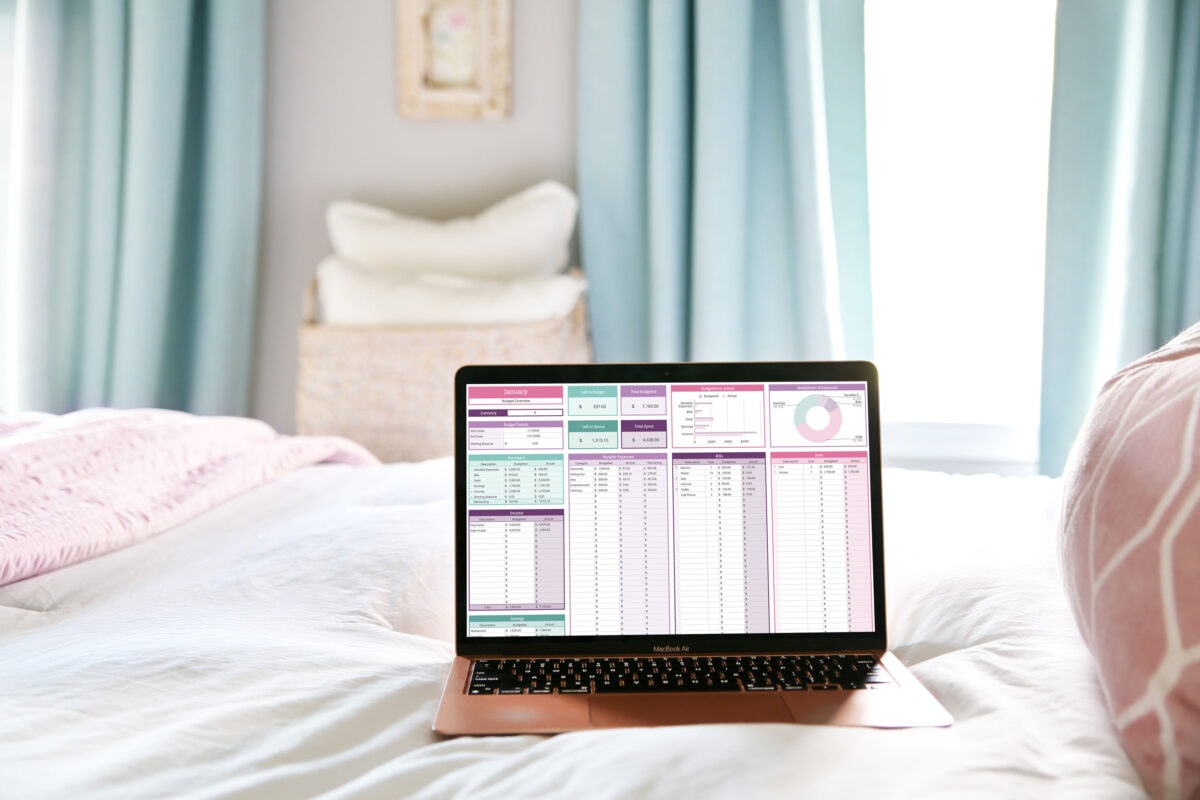
It is a simple, straightforward tool that is perfect for beginners. (And it does the math for you– just enter your transactions and let it do the rest!)
The spreadsheet lets you break down your spending by category so you can easily see where your money is going and where you can afford to cut back on your expenses. (Did I mention that it’s pretty too?!)
Many people find that just with the simple act of tracking their budget, they naturally start spending less.
You can learn more about the Monthly Budget Spreadsheet right here.
Budgeting on an Irregular Income: Final Thoughts
I avoided budgeting for years because I was afraid it would feel too overwhelming or restrictive.
But once I got into a solid money routine, budgeting actually became very freeing! Suddenly, I was in charge of where our money went.
I knew what we could afford and where we could cut back.
And I had confidence that we were making smart money decisions that would benefit us far into the future.
Happy Budgeting!
Want to save this post to revisit later? Be sure to pin the image below so you can find it easily!
More Ways to Organize Your Finances
Thank you so much for following along! Have a wonderful day!

I am not a financial professional. The information in this post is for educational purposes only and is not considered personalized financial advice.